Showing posts with label Europe Plants. Show all posts

Bird Cherry

>> Wednesday, January 11, 2012


Description
Scientific Names: Prunus padus
Common Names: Bird Cherry, Hackberry
Plant Type: Mid-size spring flower.
Height: 2–12 m (7–40 ft.).
Native Habitat: Broadleaf woods, streamsides, waterside thickets, forest margins. Also an ornamental.
Native Range: Europe, northern Asia to central Japan.
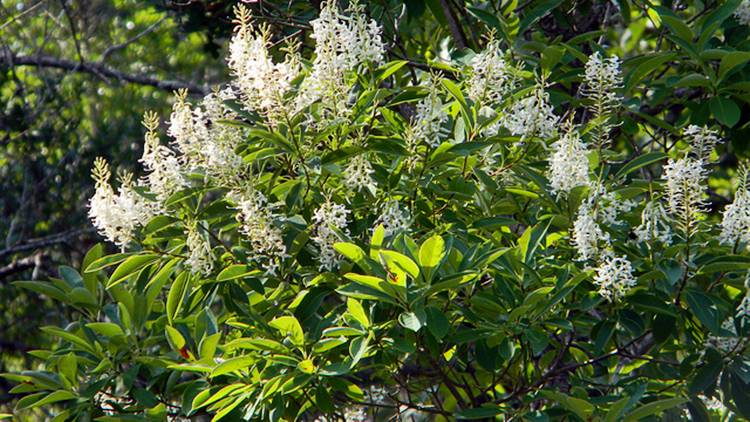
Flower: Showy flowers, fragrant flowers. Regular (actinomorphic), fairly small. Calyx-lobes 5, short, triangular. Petals 5, white, rarely reddish. One carpel. Stamens more than 20. Inflorescence a many-flowered, pendent raceme.
Flowering Time: April-May.


The cherries and plums (Prunus spp.) forming a genus of nearly 100 species. Most of the species occur in the temperate zone of the northern hemisphere. The Bird Cherry showily flowers in early summer. It is a shrub or small tree that is very demanding in terms of the growing substrate, but also thrives in the shade. But in short light it produces fewer flowers and often forms dense stands with drooping branches. The heavy-scented flowers attract insects, especially flies and bees. The wood and bark of this species contain a poisonous glycoside which breaks down into benzaldehyde (bitter almond oil) and hydrogen cyanide. These compounds cause a strong odor and taste, which act as an effective defense against herbivory. Nevertheless, the larva of certain moths (family Yponomeutidae) is not uncommon for the trees in white silky web and eat the leaves.


The black fruits of bird cherry is bitter-sweet. They can to produce a tasty liqueur or dyeing of wool, as they will yield a pale purple shade used. In northern Lapland, the dominant subspecies borealis. It is hairy and the flowers are mild scent. The fruit of this tree is rarely used in Western Europe, but is often eaten on the east. It was used medicinally in the Middle Ages. The bark of the tree, placed at the door should be, to ward off plague. It is also sold as an ornamental plant in North America as May Day tree. A taboo on the use of wood was reported by indigenous Advie, in the north east of Scotland is called a "witch tree".


Uses
Used as ornamental trees, spring flowers are the best ornamental feature. Medium-sized tree for sunny landscape areas. Can also be used as a shade plant or as a street tree that will surely add to the beauty of the place. They can to produce a tasty liqueur or dyeing of wool, as they will yield a pale purple shade used.

Read More - Bird Cherry

Georgia Plume

>> Saturday, January 7, 2012


Description
Scientific Name: Elliottia racemosa
Common Names: Georgia Plume, Southern Plume
Plant Type: Small deciduous tree.
Height: 6-8 feet (at 10 years).
Native Habitat: Moist stream banks to dry ridges, usually in sandy soil.
Native Range: Scattered locations in eastern and southern Georgia. Once know from a site in South Carolina (collected in 1853). Rare though locally abundant it may also occur in cultivation.
Conservation Status: NatureServe lists Elliottia racemosa as Imperiled or Vulnerable in Georgia and Possibly Extirpated in South Carolina. The state of Georgia officially classifies it as Threatened.
Cultivation: Give this plant acid well-drained soil in sun or partial shade. Wild plants often spread by root suckering, so pruning may to needed to get a tree form. Root rot is another possible problem, especially on poorly-drained soils.
Flowering Time: Late (July).


Elliottia racemosa or the Georgia Plume is a very rare small tree or large shrub in the ericaceae or rhododendron family, originally from the state of Georgia. A review of the literature on it reveals a story of frustration and disappointment. Despite the fact that it was discovered 170 years or more, and despite the fact that, because of its decorative qualities often described, it is still extremely rare in cultivation. Attractive white plumes of flowers appear in July. Georgia Plume is a rare small tree in Georgia, where he is officially listed as an endangered species found. It takes its name from the beautiful plume like spikes of fragrant white flowers appear in early summer. Since these peaks for up to a foot, a plant in full bloom can be quite striking.


Each inflorescence may be several dozen individual flowers that open gradually from base to tip, and have curved petals similar to those found on some native azaleas. In fact, the way a member of the heath family, which includes azaleas. The flowers develop into small round capsules with up to 40 seeds. The attractive elliptical leaves are about 4 inches long and can be a bright red or scarlet before dropping again in the autumn. Wild plants, which sometimes grow to 30 feet high, found on both wet and dry brook ridge. Because it is so rare Georgia Plume is getting difficult, but the system is maintained. Like most members of his family moves, it has an acid well-drained soil in sun or part shade. Old reports indicate that this species once grew at a site in South Carolina, but there is apparently no longer present. There were also losses of population in Georgia, especially in areas where pine plantations have been established. But the plants are protected in some locations, and efforts are made to insure the survival of the species.


Uses
Although very rarely but Georgia Plume used as an ornamental plant. Georgia Plume has a shape and color of beautiful flowers, but on the other hand these plants include plants that hard to be kept. Diminishing the number of plants in nature is becoming very rare even in their natural habitat. A pride if it can kept maintain these plants.

Read More - Georgia Plume

Franklin Tree


Description
Scientific Name: Franklinia alatamaha
Common Names: Franklinia, Ben Franklin Tree, Franklin Tree, Lost Franklinia
Plant Type: Small deciduous tree.
Height: 10 to 20 feet.
Native Habitat: Best grown in organically rich, medium moisture, well-drained soils in full sun to part shade. Must have good soil drainage. Consider raised plantings in poorly-drained heavy clay soils such as those present in much of the St. Louis area. Perhaps best in full sun in northern climates, but appreciates some afternoon shade in hot summer climates. May not be reliably winter hardy in the northern. Hard to transplant because of its sparsely fibrous root system, and is best left undisturbed once planted in the landscape.
Native Range: Southeastern United States.
Cultivation: Franklinia humus-rich acid soil, and water it during dry spells, especially when young. Good drainage is essential, so consider putting it on an elevated spot or artificial mound. It blooms most profusely in full sun, but in hot dry climates partial or dappled shade might give the best overall results. Sometimes this plant will try to grow as a shrub, but it can usually be trained into tree form. Franklinia is easy to grow from seed, and such a plant will often reach blooming size by the sixth year.
Related Species: There are no other species in this genus. The plant is distantly related to Loblolly-bay (Gordonia lasianthus), and to the Camellias and Stewartias (such as Stewartia ovata).
Flowering Time: July to August.


The Lost Franklinia is apparently extinct in the wild. All known living specimens are crops grown probably descended from a few trees (or maybe just a tree) in the garden of the eighteenth century botanist William Bartram and John. Bartram discovered the species in 1765, when they found a small stand of trees on a sandy hill near the Altamaha River in Coastal Georgia. These trees in the coming decades disappeared, possibly destroyed by clearing activities in the field. Despite numerous investigations no other wild specimens have ever been found. The Lost Franklinia is Ben Franklin Tree, or Tree Franklin, a name given him by Bartram in honor of their friend Benjamin Franklin. The species name "Alatamaha" is an old spelling for the name of the river, on which the plant was discovered.


Cultivated specimens Franklinia bushy plants are usually less than 20 meters high, often with multiple trunks. The tree does not bloom until late summer, when it bears attractive three-inch flowers with white petals and orange stamens. Individual flowers open over a long period, even in mid-fall. The fruit is a small, round capsule with a number of flat seeds. Leaves turn vibrant orange-red in late autumn before dropping. Although the only known wild trees growing in Georgia, cultivated specimens usually best in the northern regions. The poorly drained clay soils found in many parts of the South increases the susceptibility to root rot diseases, and there are indications that the current (or former) cotton-growing areas, a pathogen that kill the plant port.


The species can be successfully moved to the south, but it is difficult to know beforehand whether a particular place implants, has the right conditions. The good cold hardness of the surviving plants, suggesting that Franklinia may originally have been forced from the North originally, but had to migrate south during the Ice Age to the extreme cold and the repeated incursions of the ice to escape. But could be the conditions in the south, less suitable for them to have the Ice Age ended. If it has stranded there, it could begin to die as the climate has warmed up again. The plants of Bartram had discovered the last survivors of the once much larger population. Conceivable that kind could escape from cultivation and re-establish himself free in the wild. Deliberate attempts to restore it can be performed. But it is doubtful that the species could survive on its own for a longer period. Because existing systems are so closely related, as a group they may not have needed genetic diversity to resist new diseases or adapt to a changing climate.


Uses
Specimen tree or large shrub valued for its late summer flowers, good fall color and interesting history. Deserves a prominent location in the landscape. Used as a plant flowers.

Read More - Franklin Tree