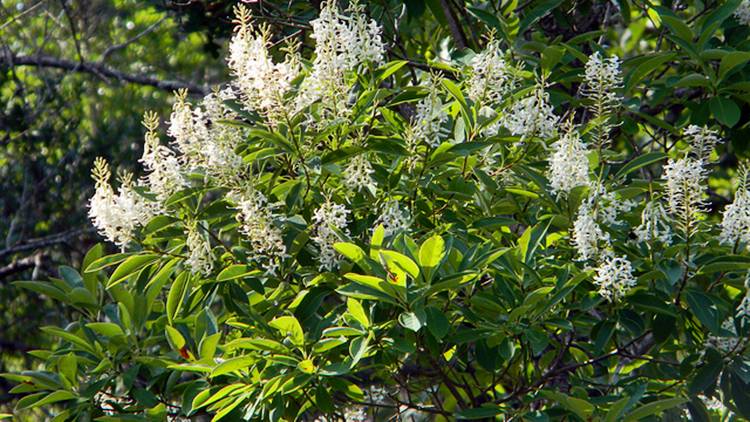
American Smoketree

>> Sunday, January 8, 2012


Description
Scientific Names: Cotinus obovatus, Cotinus americanus
Common Names: American Smoketree, Chittamwood
Plant Type: Mid-size deciduous tree.
Height: 20 to 30 feet.
Native Habitat: Rocky uplands and ravines, openings in hardwood forests.
Native Range: Southern United States. Scattered populations in an irregular pattern from Tennessee to south-central Texas.
Conservation Status: NatureServe lists Cotinus obovatus as Critically Imperiled in Georgia, Imperiled in Tennessee and Alabama, and Vulnerable in Oklahoma. Officially the species is put into the category of Special Concern in Tennessee.
Cultivation: Although the American Smoketree can survive harsh conditions and neglect, it grows faster and blooms more profusely in good soil and a sunny exposure. It is more tolerant of alkaline soils than most native species, but may dislike permanently-moist conditions. Do not over-fertilize. Seeds need both warm and cold stratification, and can take up to two years to germinate.
Related Species: There are no other native species in this genus. The common smoketree generally sold in nurseries is an import from Eurasia.
Bloom Time: May to June.


Native to Missouri, American Smoketree is a small, rounded, deciduous tree or large shrub that matures to 20-30 ft tall. The common name comes not from its large greenish yellow flower clusters in June, but from the billowy smoky pink plumes that follow the flowers. Smoke display continues through much of the summer. Exciting fall color includes yellow, orange, red and reddish purple. Best growth occurs in somewhat infertile, well-drained soils.


The American Smoketree gets its name from its clusters of tiny blossoms which from a distance look like puffs of smoke. The individual blossoms are greenish-white, but the fuzzy flower stalks, which can be pink or purple, add additional color. The effect is often subtle, and male trees usually put on a somewhat showier display. The flowers on female trees develop into small seeds that are eaten by some finches. The leaves, which are bright green in summer, can turn to a spectacular orange-red before dropping in autumn. Specimens in sunny locations generally have the best color, but genetic variations or soil characteristics may have an influence.


American Smoketree should not be confused with the non-native Common Smoketree (Cotinus coggygria), which is sold in many nurseries and often planted in yards. The American plant, though in some ways more attractive, is much less common in landscapes. It is also very uncommon in the wild, being mostly restricted to isolated stands in an irregular band from Tennessee to Oklahoma and Texas. In cultivation the species has proven to be cold hardy in the north, which suggests that it once grew there. Possibly it migrated toward the south during the ice ages, but still retains its former cold-hardiness. Despite its rarity, the American Smoketree is easy to grow. It is tough enough to tolerate rocky alkaline soils and long droughts. Young plants in sunny locations can grow rather rapidly, up to two feet a year.

Read More - American Smoketree

Pigeonberry


Description
Scientific Name: Cornus alternifolia
Common Names: Pagoda Dogwood, Alternate-leaf Dogwood, Pigeonberry
Plant Type: Small deciduous tree.
Height: 10 to 15 feet. Reaches a maximum height of around 25 feet.
Native Habitat: Understory of mixed forests. Grow in acidic, organically rich, medium moisture, well-drained soil in full sun or partial shade. Best performance occurs in cool summer climates. Give consistent moisture and mulch the root zone.
Native Range: Native to the eastern United States, especially northern regions.
Conservation Status: NatureServe lists Cornus alternifolia as Imperiled in Delaware, Florida, and Mississippi. Officially the species is classified as Endangered by Florida.
Cultivation: This plant is shade-tolerant, but will look and perform better in sunlight. Give it slightly-acid well-drained soil and water young plants during dry spells.
Related species: Argentea (sometimes listed as Variegata), the only commonly available variety is a rare form that difficult to propagate and therefore fetches a high price. There is a small, shrubby plant (up to 15 feet high) with layered branches and leaves, which are beautifully colored with a white border. Other nurseries begin to offer this choice in greater numbers.
Flowering Time: May to June.


Pagoda dogwood is a small tree, the undergrowth a large part of the eastern United States. It is its common name from its pagoda-like horizontal branch. An older name, Pigeonberry refers to the fruit that was once a favorite food of the now-extinct passenger pigeon. Its scientific epithet alternifolia, refers to the leaf pattern, changes differently than most dogwoods, along the stem. This plant blooms are not as showy as those of the common dogwood flowers, but they are still attractive. They are creamy or yellowish-white, very fragrant, and form clusters at the ends of the branches. The flowers are berries that gradually changes from green to red to blue-black, followed on red stems. These berries are a valuable food for birds and other wildlife.


The leaves can turn a beautiful reddish-purple before they fall in autumn. The color varies from tree to tree, and may partly depend on growth. The light brownish-gray bark, together with the interesting branching structure, give the plant respond in the winter. This species is found over much of the eastern United States, but there are small genetic differences between plants from different regions. For this reason, plants from a southern seed source is not grown well in the north and vice versa. Pagoda Dogwood is vulnerable to a range of diseases, including branch plagues and cancers. But the way seems to be resistant to dogwood anthracnose, which has killed over the past few years, many flowering dogwood.


Uses
Used as ornamental trees spring flowers are the best decorative feature. Plant as a specimen or in small groups on residential property in houses, near patios or in lawns. Also effective in shrub borders, woodland gardens, bird gardens or naturalized areas.

Read More - Pigeonberry

Georgia Plume

>> Saturday, January 7, 2012


Description
Scientific Name: Elliottia racemosa
Common Names: Georgia Plume, Southern Plume
Plant Type: Small deciduous tree.
Height: 6-8 feet (at 10 years).
Native Habitat: Moist stream banks to dry ridges, usually in sandy soil.
Native Range: Scattered locations in eastern and southern Georgia. Once know from a site in South Carolina (collected in 1853). Rare though locally abundant it may also occur in cultivation.
Conservation Status: NatureServe lists Elliottia racemosa as Imperiled or Vulnerable in Georgia and Possibly Extirpated in South Carolina. The state of Georgia officially classifies it as Threatened.
Cultivation: Give this plant acid well-drained soil in sun or partial shade. Wild plants often spread by root suckering, so pruning may to needed to get a tree form. Root rot is another possible problem, especially on poorly-drained soils.
Flowering Time: Late (July).


Elliottia racemosa or the Georgia Plume is a very rare small tree or large shrub in the ericaceae or rhododendron family, originally from the state of Georgia. A review of the literature on it reveals a story of frustration and disappointment. Despite the fact that it was discovered 170 years or more, and despite the fact that, because of its decorative qualities often described, it is still extremely rare in cultivation. Attractive white plumes of flowers appear in July. Georgia Plume is a rare small tree in Georgia, where he is officially listed as an endangered species found. It takes its name from the beautiful plume like spikes of fragrant white flowers appear in early summer. Since these peaks for up to a foot, a plant in full bloom can be quite striking.


Each inflorescence may be several dozen individual flowers that open gradually from base to tip, and have curved petals similar to those found on some native azaleas. In fact, the way a member of the heath family, which includes azaleas. The flowers develop into small round capsules with up to 40 seeds. The attractive elliptical leaves are about 4 inches long and can be a bright red or scarlet before dropping again in the autumn. Wild plants, which sometimes grow to 30 feet high, found on both wet and dry brook ridge. Because it is so rare Georgia Plume is getting difficult, but the system is maintained. Like most members of his family moves, it has an acid well-drained soil in sun or part shade. Old reports indicate that this species once grew at a site in South Carolina, but there is apparently no longer present. There were also losses of population in Georgia, especially in areas where pine plantations have been established. But the plants are protected in some locations, and efforts are made to insure the survival of the species.


Uses
Although very rarely but Georgia Plume used as an ornamental plant. Georgia Plume has a shape and color of beautiful flowers, but on the other hand these plants include plants that hard to be kept. Diminishing the number of plants in nature is becoming very rare even in their natural habitat. A pride if it can kept maintain these plants.

Read More - Georgia Plume

Franklin Tree


Description
Scientific Name: Franklinia alatamaha
Common Names: Franklinia, Ben Franklin Tree, Franklin Tree, Lost Franklinia
Plant Type: Small deciduous tree.
Height: 10 to 20 feet.
Native Habitat: Best grown in organically rich, medium moisture, well-drained soils in full sun to part shade. Must have good soil drainage. Consider raised plantings in poorly-drained heavy clay soils such as those present in much of the St. Louis area. Perhaps best in full sun in northern climates, but appreciates some afternoon shade in hot summer climates. May not be reliably winter hardy in the northern. Hard to transplant because of its sparsely fibrous root system, and is best left undisturbed once planted in the landscape.
Native Range: Southeastern United States.
Cultivation: Franklinia humus-rich acid soil, and water it during dry spells, especially when young. Good drainage is essential, so consider putting it on an elevated spot or artificial mound. It blooms most profusely in full sun, but in hot dry climates partial or dappled shade might give the best overall results. Sometimes this plant will try to grow as a shrub, but it can usually be trained into tree form. Franklinia is easy to grow from seed, and such a plant will often reach blooming size by the sixth year.
Related Species: There are no other species in this genus. The plant is distantly related to Loblolly-bay (Gordonia lasianthus), and to the Camellias and Stewartias (such as Stewartia ovata).
Flowering Time: July to August.


The Lost Franklinia is apparently extinct in the wild. All known living specimens are crops grown probably descended from a few trees (or maybe just a tree) in the garden of the eighteenth century botanist William Bartram and John. Bartram discovered the species in 1765, when they found a small stand of trees on a sandy hill near the Altamaha River in Coastal Georgia. These trees in the coming decades disappeared, possibly destroyed by clearing activities in the field. Despite numerous investigations no other wild specimens have ever been found. The Lost Franklinia is Ben Franklin Tree, or Tree Franklin, a name given him by Bartram in honor of their friend Benjamin Franklin. The species name "Alatamaha" is an old spelling for the name of the river, on which the plant was discovered.


Cultivated specimens Franklinia bushy plants are usually less than 20 meters high, often with multiple trunks. The tree does not bloom until late summer, when it bears attractive three-inch flowers with white petals and orange stamens. Individual flowers open over a long period, even in mid-fall. The fruit is a small, round capsule with a number of flat seeds. Leaves turn vibrant orange-red in late autumn before dropping. Although the only known wild trees growing in Georgia, cultivated specimens usually best in the northern regions. The poorly drained clay soils found in many parts of the South increases the susceptibility to root rot diseases, and there are indications that the current (or former) cotton-growing areas, a pathogen that kill the plant port.


The species can be successfully moved to the south, but it is difficult to know beforehand whether a particular place implants, has the right conditions. The good cold hardness of the surviving plants, suggesting that Franklinia may originally have been forced from the North originally, but had to migrate south during the Ice Age to the extreme cold and the repeated incursions of the ice to escape. But could be the conditions in the south, less suitable for them to have the Ice Age ended. If it has stranded there, it could begin to die as the climate has warmed up again. The plants of Bartram had discovered the last survivors of the once much larger population. Conceivable that kind could escape from cultivation and re-establish himself free in the wild. Deliberate attempts to restore it can be performed. But it is doubtful that the species could survive on its own for a longer period. Because existing systems are so closely related, as a group they may not have needed genetic diversity to resist new diseases or adapt to a changing climate.


Uses
Specimen tree or large shrub valued for its late summer flowers, good fall color and interesting history. Deserves a prominent location in the landscape. Used as a plant flowers.

Read More - Franklin Tree

Mountain Pepperbush

>> Thursday, January 5, 2012


Description
Scientific Name: Clethra acuminata
Common Names: Cinnamon Clethra, Cinnamonbark Clethra, Mountain Pepperbush
Plant Type: Small deciduous tree; sometimes shrublike.
Height: 12-36 feet.
Native Habitat: Mountainous areas in understory or openings near streams.
Native Range: Found mainly in the southern mountains.
Conservation Status: NatureServe lists Clethra acuminata as Critically Imperiled in Alabama and Pennsylvania. The species is officially classified as Endangered by Pennsylvania.
Cultivation: Give this plant moist humus-rich acid soil with good drainage, and water during droughts, especially when young. Fertilize lightly or not at all. It can tolerate shade, but will grow faster and bloom better in a sunny location. The tiny seeds should be sown under glass in spring.
Related Species: Summersweet (Clethra alnifolia) is a similar but smaller and shrubbier eastern native. Other clethras are found in Asia.
Bloom Time: June, July, August.


Cinnamon Clethra is a small deciduous tree native to the southern Appalachian region. It's common name comes from the beautiful color of cinnamon bark, which is, of course, replace the outer layers as revealed. In fact, the color varies somewhat, from gold to pink and red ocher variations of the same plant can create a mottled pattern. The effect is particularly evident in winter.


The tree is also called Cinnamonbark Clethra. Another common name, Mountain Pepperbush, comes from its spicy-tasting seeds, used the early settlers as a substitute for black pepper. The flowers, long spikes of small white bells appear in early summer when few other plants bloom. The individual flowers open sequentially from the base to the top of the tower and are a good source of nectar for butterflies. The rich green leaves are oval-shaped with a tip and turn golden or yellow in autumn before dropping. The tiny seeds are to germinate best when they fall on mossy ground. This plant sometimes tempted to grow as a shrub, but can be cut in general to a tree form. This is generally preferred because it accentuates the effect of the beautiful bark. Also in tree form, the plant rarely grows more than 20 meters high and is therefore an excellent choice for small properties. Because it is a sub-type timber, it can survive in fairly heavy shade, but it will bloom much better if it receives at least a few hours of direct sunlight.


Clethra acuminata is found in small scattered populations from southern Pennsylvania to northern Alabama. The national co-champions, both grow about 30 feet high, in the Great Smoky Mountains National Park. Wild plants are usually found in damp areas, but cultivated specimens can be adapted to dry habitats. This is a very attractive landscape plant.


Uses
The seeds have a spicy taste that can be used as a substitute for black pepper. That's why this plant got the name Mountain Pepperbush.

Read More - Mountain Pepperbush

Mountain Camellia


Description
Scientific Names: Stewartia ovata, Stuartia ovata
Common Names: Mountain Camellia, Mountain Stewartia, Summer Dogwood, Showy Stewartia
Plant Type: Small deciduous tree.
Height: 15 to 20 feet.
Native Habitat: Understory of hardwood forests, often near streams. Usually below 2500 feet.
Native Range: Scattered areas in the central and southern United States.
Conservation Status: NatureServe lists Stewartia ovata as Imperiled in North Carolina, South Carolina, and Virginia; Critically Imperiled in Mississippi; Imperiled or Vulnerable in Alabama; and possibly Vulnerable in Georgia and Kentucky.
Cultivation: Mountain stewartia can tolerate fairly heavy shade, but will grow faster and bloom more profusely if it receives at least a few hours of direct sunlight. It can take full sun in cooler climates, but partial or dappled shade might be best in the South. Try to give it a moist humus-rich soil with good drainage, and keep young trees well-watered, especially in hot climates or sunny exposures. Droughts can cause early leaf drop. Seeds require about 5 months warm stratification followed by about 3 months of cold stratification.
Related Species: A similar native species, Stewartia malacodendron, is found in scattered locations from Virginia to Texas, mostly at low elevations near the coast. Known as Silky camellia or Virginia stewartia, it has four-inch white blossoms with purple stamens and blue antlers. The only other Stewartia species are native to Asia, Stewartia pseudocamellia or Japanese stewartia is a small, slow-growing, pyramidal, deciduous tree which typically matures over time to 20-40 feet tall, this plant located in Japan. More distant relatives include Franklinia and various camellias.
Flowering Time: July.


The Mountain Camellia is a rare small tree native to the southern Appalachian region. It is removed with the evergreen camellias of Asia and used them in some ways resembles, but is not always green. As we rest in the case, it can better survive the cold winters American. The plant is called Mountain Stewartia and Summer Dogwood. It is most common in low and middle altitudes of the Great Smoky Mountains and on the Tennessee portion of the Cumberland Plateau. Some isolated populations are also in other areas, including small stands near Williamsburg, Virginia, and found in northern Mississippi.


The type blooms later than most native plants, the early to mid summer. His beautiful camellia flowers are about 3 inches wide, white waxy leaves and yellow stamens. There is also an uncommon form called Stewartia ovata Grandiflora, which has larger flowers and purple stamens. This form, sometimes known as Showy Stewartia is reportedly most common in the state of the trees in the vicinity of Williamsburg, but it has also been observed in other areas. Wild specimens are usually less than 20 meters high and often bushes. They grow in the forest undergrowth or on the edges of the openings along streams. The leaves are oval shaped and orange, red or gold in autumn before dropping. Woody seed capsules, about 1 cm long, can hang on the tree in the winter. Stewartia ovata as a species seems quite variable.


Horticulturist Polly Hill planted seeds collected from samples of the Grandiflora form and found some remarkable differences between the resulting plants. The flower shown on this page, with purple stamens and orange antlers is, form a Grandiflora. The photo was taken in the Great Smoky Mountains National Park. According to some authorities, the proper scientific name for this type Stuartia ovata, but the older name Stewartia ovata is still in common usage. Mountain Camellia can be difficult to obtain and difficult to grow. But if you be successful with it to be, you have a very rare and beautiful plant.


Uses
Lawn specimen, patios, shrub borders or native plant garden. This unusual tree deserves a prominent place in the landscape. Many people use this plant as an ornamental plant because this plant has a very beautiful flower. On the other hand, these plants began threatened in their natural habitat. Mountain Camellia can be difficult to obtain and difficult to grow. But if you are successful on him, you have a very rare and beautiful plant.

Read More - Mountain Camellia

Carolina Silverbell


Description
Scientific Names: Halesia tetraptera, Halesia carolina
Common Names: Carolina Silverbell, Four-winged Silverbell, Silverbell
Plant Type: Small to large deciduous tree.
Height: 20-40 feet can form, but be much larger mountain.
Native Habitat: Halesia grows mostly in the mountains. Growth is best in moist, fertile, well-drained, slightly acidic soils with lots of organic matter. Plants prefer full sun or partial shade on cool, sheltered sites. Halesia transplants well as balled and burlapped or container-grown stock. It can be propagated by seed, root and greenwood cuttings and air layering.
Native Range: Scattered areas in central and southeastern United States, extending west to Oklahoma.
Conservation Status: NatureServe lists endangered Halesia tetraptera as critical in Illinois, and endangered in Alabama and Oklahoma. Officially the species is considered endangered and Illinois Presumed eradicated through Ohio.
Cultivation: Carolina Silverbell can burn sensitive to drought and fertilizer. Give it a moist loamy soil with good drainage, and go light on fertilizer. A mulch can help preserve moisture during dry periods. Direct sunlight increases the flower, but too much sun can cause stress in hot, dry climates. The system can be several strains or trying to grow as a shrub, but can be trained usually in the form of a tree. Seeds need both warm and cold stratification and can be difficult to work with.
Related Species: A similar type is the Two-winged Silverbell (Halesia Diptera), also known as the snowdrop tree. This is a southern species, and it can make a very good alternative in warm climates, but may not survive to the north. Some nurseries sell a special form called magniflora, the bigger and stronger, has flowers. Two-winged Silverbell is slightly smaller than Carolina Silverbell, usually less than 25 meters high. Another similar species, Little Silverbell (Halesia parviflora), which grows along the Gulf coast and could be grown in this region. The flowers are only half as large as that of the other two species. There is also a more distantly related species called Bigleaf Snowbell (Styrax grandifolius). An undergrowth plant with white bell-shaped flowers, it can either grow as a shrub or a tree, and rarely more than 20 meters high. A smaller but similar species known to reach American Snowbell (Styrax americana) to about 10 meters. Each of these could be a good alternative to the Silverbells, where space is limited.
Flowering Time: April-May.


Carolina Silverbell is a deciduous tree native to central and southern United States. It takes its name from the beautiful bell-shaped flowers that hang from the branches in mid spring. These flowers, about 3 / 4 inch long, are usually pure white, but can also be pink. Regardless of color, they have a delicate beauty that no one will forget. The tree grows tall, usually about 30 meters, but a great form known as Mountain Silverbell are able to reach 100 feet. This form is found mainly in the southern Appalachians, is sometimes classified as separate species (Halesia monticola). It has larger leaves and flowers smaller than the form.


The tree can grow in fairly heavy shade, and is usually found in moist soil, often near streams. The leaves are oval and can be in a clear, turn yellow before dropping autumn. The winged fruits are drupes about an inch long, which are sometimes eaten by squirrels. As these stone fruits have four wings, the plant is sometimes referred to as Four-winged Silverbell. It's scientific name, formerly Halesia carolina,has been changed to Halesia tetraptera.


This species is found over a larger geographical area, as far north as West Virginia and southern Illinois, as far west as Oklahoma, and south to northern Florida. But it is spread thinly over much of its range and is becoming increasingly rare in many regions, especially in populated areas. Fortunately, there a number of nurseries propagate and therefore now available to the public. As more and more people plant them in their courts, it should at some point the appreciation it deserves.


Uses
Attractive, small tree or large shrub for the shrub border or woodland garden. Interesting design for the lawn. Grows well with rhododendrons and azaleas. Usually used as a flowering tree.

Read More - Carolina Silverbell